Hydroseeding vs. Drill Seeding for Pastures and Large Lots
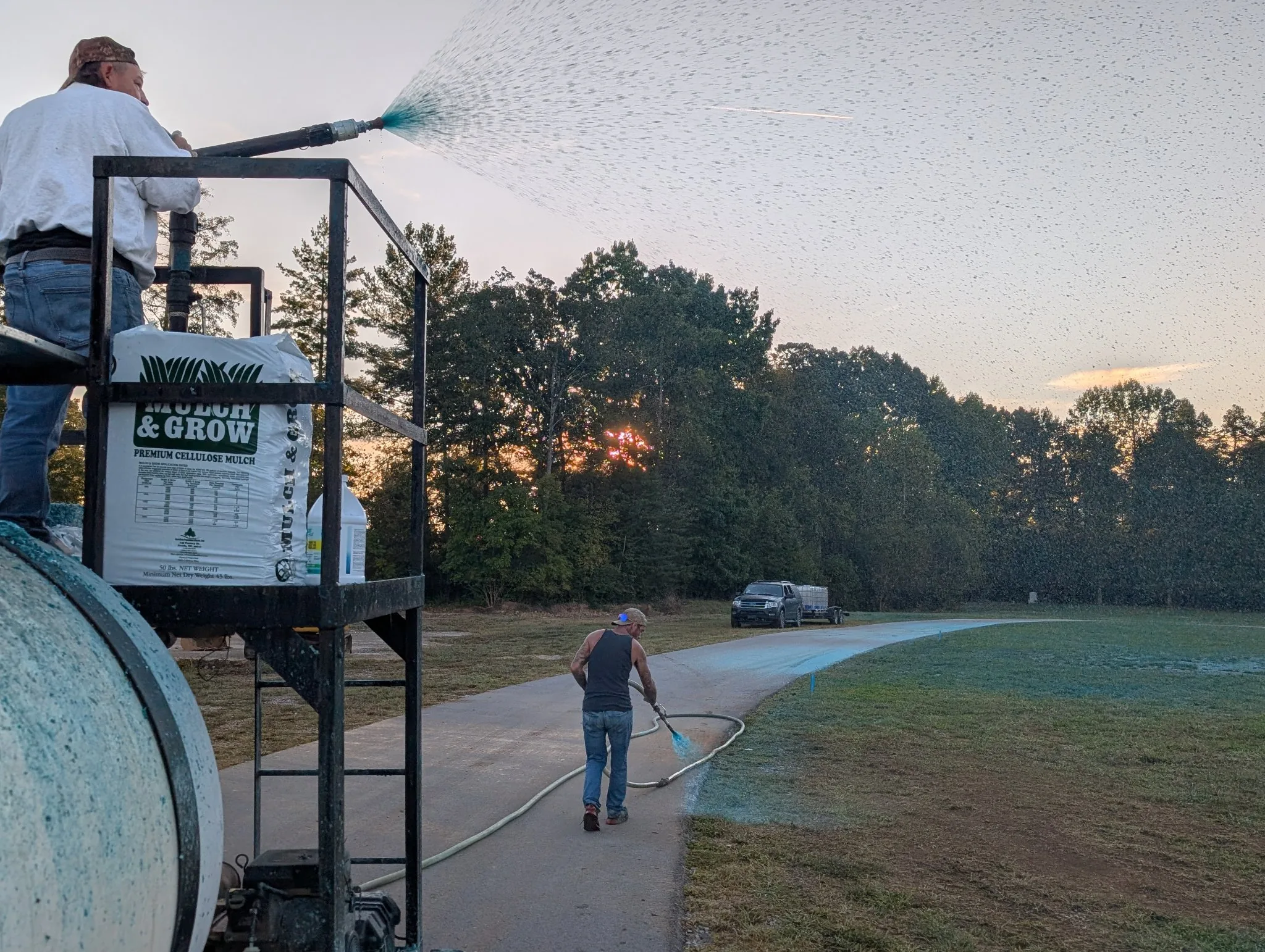
When the job is measured in acres instead of square feet, East Tennessee landowners usually end up comparing two methods: hydroseeding and drill seeding. Both are legitimate ways to get grass established on pastures, fields, and large lots around Knoxville, and neither is the right answer for every property. The difference comes down to how the seed is placed, what the ground looks like now, how much slope and roughness you have, and whether you are building a lawn, a pasture, or erosion cover on a homesite that happens to be big.
A drill seeder is a machine pulled behind a tractor that cuts small furrows in the soil and drops seed into them at a set depth, then firms the ground over it. Done on prepared, reasonably smooth ground, it is efficient and proven, especially on flatter agricultural land where a tractor can work in clean passes. Seed sits at a consistent depth, tucked into the soil, which suits many pasture plantings. The catch is in the preparation and the terrain. A drill needs ground that is workable and relatively free of rocks, stumps, and steep sections, and it does not love the broken, rolling, partly cleared land that a lot of large residential lots in our area actually are.
Hydroseeding sprays a slurry of seed, mulch, starter fertilizer, and tackifier over the surface. It does not need furrows, a tractor path, or uniform ground to do its work, so it handles irregular shapes, slopes, and areas around trees, drives, and buildings that a drill cannot reach gracefully. The mulch holds moisture at the surface and protects the seed while it germinates, which matters on exposed ground. On steep or eroding sections, the tackifier helping the mix cling is a real advantage over seed dropped in rows that a hard rain can find and follow downhill.
For a true working pasture on open, tractor-friendly ground in Anderson or Loudon County, a drill is often a sensible, economical tool, and we will say so. The equation changes when the large lot is really a homesite: five acres around a new house in Seymour or Kingston, part lawn, part slope, part rough edge that just needs cover before it washes. There, hydroseeding's flexibility usually wins, because one application can handle the finished yard by the house and the raw back acre in the same visit, with the same mix, without moving two kinds of equipment onto the property.
Water and timing deserve a thought in both methods. Drilled seed sits in soil and can wait a bit more patiently for rain. Hydroseed at the surface germinates fast when kept damp but asks more of your watering on smaller areas. On acreage without irrigation, both methods in East Tennessee are really fall conversations, when rainfall patterns and cool nights do heavy lifting that no hose system on five acres ever will. Choosing the season honestly matters more than choosing the machine proudly.
Cost through our service is easy to state: $6,000 per acre for larger properties, and $700 per tank covering up to 2,500 square feet for smaller areas, with seed, mulch, and starter fertilizer included. There is more on how large jobs are scoped at Knoxville hydroseeding if you are pricing land now. And if a small spot does not take, we offer free return visits to fix it, which applies to a corner of a big lot just as it does to a subdivision yard.
If you have pasture or a large lot and are torn between methods, call 423-358-2317 or request a free quote. Describe the land as it really is, rough spots and all, and we will tell you plainly which method serves it better, even when the honest answer is the drill.
Want it handled start to finish? The East Tennessee hydroseeding crew does the prep, the spray, and the follow-up.
Every yard is different. Get a free quote from East Tennessee hydroseeding before you decide.